miércoles, 4 de noviembre de 2009

Benedicció especial

Entre els molts grups socials i castes que hi ha a la Índia hi ha un que crida l’atenció d’una manera força especial. Són els anomenats “hijras”. Amb aquest nom es coneix els eunucs, transsexuals i transvestits del país. Alguns són homes castrats, és a dir, amb els genitals mutilats; altres, simplement, són homes que se senten dones i actuen com a tals. Tots ells vesteixen robes femenines, és a dir, saris i habitualment van molt maquillats. És fàcil trobar-los en petits grups o parelles, tot demanant almoina als trens o als semàfors de les grans ciutats. No demanen, però, de la mateixa manera que ho fa la resta de pidolaires indis, és a dir, posant cara de llàstima, xiuxiuejant unes paraules i portant-se la mà a l’estomac. Ells (elles) assalten als viatgers amb veu enèrgica, sovint cantant i ballant, i reclamant deu, vint o cinquanta rúpies amb atreviment. Tot i que els consideren com un grup marginal, molta gent accedeix a pagar-les les quantitats que demanen, ja que temen les seves malediccions i, pel contrari, les seves benediccions són molt ben rebudes. És per això que són especialment ben pagades en celebracions important com casaments i festes en motiu del naixement d’un fill.

A la Fira de Pushkar vaig trobar un grup de cinc o sis transvestits i eunucs. Anaven passant per cadascuna de les parades, tot cantant i demanant diners. De vegades s’asseien provocativament a la falda d’algun indi, provocant la rialla general i va més absoluta vergonya del protagonista. A una distància prudent les seguia un nombrós grup d’indis curiosos. De tant en tant, un dels eunucs feia el gest de girar-se i perseguir els espectadors. Llavors tots fugien immediatament, per tornar a congregar-se entorn d’elles als pocs segons.

Jo em vaig voler apropar per fotografiar-les, desconeixent la reacció que provocaria en elles la meva gosadia. Però sorprenentment per a mi, els va agradar que algú volgués apropar-se a elles respectuosament. Van riure als veure’s fotografiades i, fins i tot, alguna em va premiar amb una especial benedicció.

martes, 3 de noviembre de 2009

The most expensive hotel in the world

I am in the most beautiful city in India. At least it is that the people and the guide say: Udaipur, the most romantic city in India. Maybe some years ago it was right but in my opinion is not true anymore basically for two reasons. The first one is because the old part of the city is absolutely full of touristic services such as hotels, guest houses, restaurants, cafes, souvenir shops, travel agencies and Internet cafes. The second one is because the Pichola Lake, which is the heart and the main charm of the city, now is a dirty and almost dry lake. People in India have a contradictory feeling about lakes and rivers. In one hand they consider them holy places but on the other hand they use them as dumps: they wash the clothes and they throw out the rubbish there. Some people realize of this ecologic disaster and you can see in the walls some phrases telling “Save the lake”, but there isn’t any steps to solve it yet.

Well, in the middle of the Lake there is a small island and there is the Lake Palace Hotel. This old palace was built in the XVIII century and nowadays is considered one of the most luxurious and most expensive hotels in the whole world. What does it mean “most expensive in the world”? It means 500 dollars per night for the cheapest room and 5000 for the most luxurious one. What a surprising contrast! India, a country where a lot of people sleep every day in the street and a normal worker earn about 4000 rupees or 60 euros monthly also have hotels of 5000 dollars per night.

By the way, maybe some of you already know the Hotel without having being here before. How is it possible? Because a movie of James Bond called Octopussy was filmed here. In many restaurants and cafes in the city they show the film every day at 7 pm. My nicest moment today was going to the highest restaurant with terrace, eating a pizza and drinking a beer and enjoying the film, the moonlight and the view over the lake. It was a really magic moment and I could know the hotel without spending the 5000 dollars for the room.

Mitjons a l’hotel més car del món

No em podia perdre la que diuen que és potser la més bonica de totes les ciutats de la Índia. De fet, la guia comença el capítol dedicat a Udaipur amb una frase d’un coronel britànic que la definí com “el lloc més romàntic de tot el subcontinent indi”. Potser en un altre temps ho fou realment. Ara, però, és una ciutat que, al meu parer, ha perdut gran part del seu encant, bàsicament per dos motius. En primer lloc perquè compta amb una part antiga absolutament sobre explotada d’establiments turístics. Això és: pensions, hotels, restaurants, cafeteries, botigues de records, agències de viatges, llocs d’accés a Internet i salons de massatge. En segon perquè el llac Pichola, el qual constitueix el cor i el veritable encant de la ciutat, és avui un llac semi sec i totalment contaminat. Al igual que a tot arreu a la Índia, la gent té un sentiment ambivalent envers els rius i llacs, ja que per una part els consideren sagrats però per altra banda els usen com abocadors: renten la roba i llencen les escombraries en ells. Hi ha algunes consciències ecologistes que, potser per les repercussions econòmiques que els aporta el turisme, s’adonen del maltractament que es dóna al llac i per això es poden llegir en algunes parets frases com “Save the lake”, però encara no hi ha passes per resoldre el problema.

Doncs bé, al mig d’aquest llac hi ha la petita illa de Jagniwas i allà és on es troba l’Hotel Lake Palace. Aquest antic palau va ser construït al s. XVIII pel marahà de la ciutat i avui en dia és considerat un dels hotels més luxosos i més cars de tot el món. Per saciar la meva i la vostra curiositat, què significa això de “més cars del món”? Doncs significa 500 dòlars per l’habitació més senzilla i per la suite cal afegir-ne un zero més. Quin país de contrastos és l’Índia! Imagineu-vos, un país on un percentatge altíssim de la població dorm al carrer i on el sou mig d’un treballador és de 4000 rúpies, uns 60 euros, trobar un dels hotels més cars del món. M’he pres la molèstia de fer comptes i he arribat a la conclusió que aquest treballador indi necessitaria el sou de 5 anys per poder pagar una nit a la suite de l’Hotel. Curiós, oi?

Per cert, potser algú de vosaltres, sense haver estat aquí ja havíeu vist l’Hotel abans. Com és possible? Doncs perquè aquí es va rodar una pel·lícula de James Bond anomenada Octopussy. En molts dels restaurants i cafeteries de la ciutat, cada dia a les 7 de la tarda, posen la pel·lícula. El meu regal d’avui ha estat anar al restaurant amb la terrassa més alta de tota la ciutat, demanar una pizza i una cervesa, i veure la pel·lícula a la llum de la lluna, amb el llac de fons i la crida del muetzí acompanyat el moment màgic. A més a més ha estat una bona manera de conèixer l’Hotel estalviant-se els 5000 dòlars de l’habitació. Ha valgut la pena!

Hidden treasures

Udaipur is a city with many touristic places. There are several temples, palaces, art galleries and museums, even you can find here one of the most luxurious hotels in the world but also there is another kind of treasure that most of the travellers and tourists can’t find by themselves. Those treasures are only for a special kind of travellers: those who have curious look and sensitive heart.

This morning, while I was walking around the narrow streets in the city I found one of those hidden treasures. Behind a wall I heart noise of children talking and laughing. Then I opened a little door and I entered into a courtyard. There, around an old temple and under the branches of a big tree, two groups of children were having class. I remained there for some minutes, like hypnotized looking the scene. The boys wore red shirt and the girls white shirt and red tie and vest. All of them were sitting down on the floor in front of a blackboard and the table of the teacher, who was the only one sitting down in a chair. The scene was like a beautiful and coloured picture: the green branches, the red clothes, the black hair and the white teeth in each smiling face.

You must pay ticket to visit almost every palace, art gallery and museum in the city. Lucky me because you don´t need pay anything to discover the most interesting hidden treasures.

Tresors amagats

Udaipur és una ciutat amb diverses atraccions turístiques i meravelles turístiques. Hi ha temples, palaus, museus, galeries d’art i, fins i tot, un dels hotels més luxosos del món.
Però també hi ha altres tresors que passen desapercebuts per a la majoria dels viatgers i turistes. Només són accessibles a aquells qui tenen una mirada curiosa i una certa sensibilitat de cor.

Aquest matí, tot passejant pels carrerons de la ciutat m’he trobat amb un d’aquests tresors amagats. Darrera d’un mur he sentit xivarri de canalla, he travessat una porta entreoberta i he entrat en un pati interior. Allà, al voltant d’un antic temple i a sota d’un gran arbre, dos grups d’infants feien classe. M’he quedat allà una estona, mirant hipnotitzat l’escena encantadora. Els nens duien camisa de quadres vermella i les noies, camisa blanca, corbata i jersei vermells. Tots ells seien al terra, amb les cames entrecreuades, enfront d’una pissarra i la taula de la mestra, que era la única que seia en una cadira. L’escena era un preciós mosaic amb quatre colors: el verd de les branques, vermell dels vestits, els negre dels cabells i un somriure blanquíssim dibuixat en cadascuna de les cares infantils.

Per a visitar els molts palaus, galeries d’art i museus de la ciutat cal pagar entrada. Quina sort per a mi i per a la meva butxaca que habitualment no cal pagar res per descobrir els veritables tresors amagats!

All the colours of the world

People say that Rajasthan is the most colourful State in India. And I think it´s true. Here the daily life is hard and the land is almost a desert but the turbans of men and the saris of women are beautiful and colourful.

The turbans are long pieces of clothes sometimes longer than 7 meters that men roll around their heads. They are useful for protecting men from the hot and the sun but also they’re useful as protection from the sand storms in the desert. The colors are bright, such as purple, royal blue or bright pink. They don’t choose the colors just by chance but every color has a meaning. It means a social class, a religion or a family name. For example, Brahmans wear red turbans and nomadic people, black, but in some important festivities all of them wear the colorful turbans.

lunes, 2 de noviembre de 2009

Tots els colors del món

Diuen que el Rajasthan, “la terra dels reis”, és l’estat amb més colors de tota la Índia. I realment és així. Aquí la duresa de la terra, gairebé desèrtica, contrasta amb l’esclat multicolor dels turbants dels homes i dels saris de les dones.

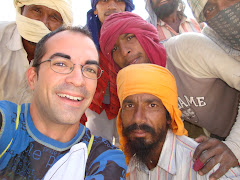
Els turbants són peces allargades de roba, de vegades amb més de 7 metres, que els homes s’emboliquen al cap bàsicament per protegir-se de la calor però també de les tempestes de sorra. Els colors solen ser llampants, com verd pistatxo, groc safrà o vermell. Però els colors no es trien per casualitat sinó que cadascú té un significat, i pot representar una classe social, una religió o una casta. Així, per exemple, els cavallers el porten groc, els bramans, vermell i els nòmades, negre. Els turbants multicolors els reserven per a les festes especials. També la manera d’embolicar-lo al cap té relació amb la classe social de qui el porta. Avui, doncs, per uns minuts, he tingut el privilegi de convertir-me en braman i m’he fet acompanyar d’un cavaller i d’un altre braman.

Eternal India

I was in this same town, Pushkar, four years ago but at that time the circumstances were different. First of all, because it was summer and it was between 40 and 45 degrees but also I felt sick. Because of this I don’t remember this place very well. Anyway I still have a very nice souvenir of Pushkar of that time: a picture that is special for me. When I was walking in the main street I met a man sitting in front of his shop and talking on his mobile. He was selling pictures of Hindu gods. I felt touched by that man who looked like such a quiet, serious and honest person. I also liked the scene of lots of Hindu gods around a man talking on his mobile. It meant to me that tradition and modernity are really mixed in India. I took a picture and that is one of my favourites.

Today while I was walking around the town I found the same street, the same shop and the same man. Maybe his beard was a little bit longer but it was the exact scene than four years ago. I greeted the man and I told him the story about me and his picture and he was happy about it. We said goodbye, joking, until the next meeting, in four years. It was very nice for both of us but that man made me think about Indian life. In those four years I’ve had the chance to do a lot of different things such as different jobs, travels, meetings. For sure, for this man, every day of each year is the same: to stay in the shop. At least it would be lucky for him if he could change his old mobile for a new one!

La Índia eterna

Fa quatre anys vaig estar en aquest mateix poble, Pushkar. Llavors, però en unes circumstàncies ben diferents. En primer lloc perquè era ple estiu i les temperatures oscil·laven entre els 40 i els 45 graus. En segon lloc perquè ens vam trobar malalts i el record que guardem d’aquest lloc no és precisament dels millors. Sí que conservo, però un detall bonic d'aquí. En un dels carrers principals em va captivar la imatge d’un senyor assegut a la porta de la seva botiga i parlant per mòbil. Era un venedor de quadres i figures de déus hindús. Em va cridar l’atenció el seu posat digne i la seva mirada amable i transparent, però també el contrast entre modernitat i tradició, la imatge d’un mòbil envoltat de tot el panteó indi. Vaig fotografiar l’escena i la considero una de les meves millors fotografies.

Avui, passejant pel poble, m’he trobat casualment amb la mateixa botiga i el mateix senyor. Potser la barba una mica més llarga. Gairebé diria que l’escena era idèntica a quatre anys enrere. He saludat al senyor amb alegria i li he explicat la història. Ell també s’ha alegrat. Ens hem acomiadat, fent broma, fins d’aquí a quatre anys més. La trobada m’ha fet pensat en la quantitat de coses diferents que he tingut l’oportunitat de fer en aquests quatre anys. Feines diferents, països visitats, nous amics, en definitiva, un munt d'experiències noves. Per a aquest senyor, en canvi, ben segur que cada dia d’aquests quatre anys ha estat igual. Amb una mica de sort, potser ha pogut canvir de mòbil!

Aquest ha estat el regal que avui m’han fet els déus hindús. La fotografia adjunta és la de quatre anys enrera. La del següent post és l'actual.

The Pushkar camel fair

I’ve had the chance to visit the Pushkar camel fair for the last couple of days. This fair is celebrated yearly during the first full moon in November and it’s one of the most important festivities in the whole country. This year it started the 28th of October and ends the 2nd of November. Pushkar is a little town in the West of India, in Rajasthan, with about 15000 inhabitants, but during the fair more than 200000 people and 50000 animals come here. The city transforms into a crazy flood of people, colours, smells, music, animals and tourists.

The fair was originally organized for buying and selling animals, mostly camels and horses. However, nowadays, there are more tourists taking pictures with the camels than people actually interested in buying them. The agenda is very interesting: acrobats, turban competitions, dentists, magicians, moustache competitions, camel races... But do you know which game is the most popular for them? The musical chairs, you know that game where you walk around a circle of chairs and when the music stops you sit down as quickly as possible... Incredible Indian people!

By the way, do you want to know how much a camel costs? Well, you can come here and return home riding your own camel for 20000 rupies, 300 euros approximately.

Els mitjons a la Fira del camell de Pushkar

He tingut la oportunitat de visitar durant un parell de dies la Fira del camell de Pushkar. Aquesta Fira se celebra cada any, durant la primera lluna plena del mes de novembre i és una de les més importants del país. Enguany s’ha celebrat entre els dies 28 d’octubre i 2 de novembre. Pushkar és un petit poble a l’oest de l’Índia, a la província del Rajasthan, amb poc més de 15000 habitants. Però durant la setmana de la Fira més de 200000 persones i 50000 animals es donen cita aquí i el poble sencer es converteix en una riuada constant de gent, colors, olors, músiques, atraccions de tot tipus, animals i turistes.

Igual que les fires de bestiar del nostre país, l’origen de la Fira de Pushkar era la compra i venda d’animals, bàsicament, camells i cavalls. Ara però hi ha més turistes fent-se fotografies amb els camells que persones interessades en comprar-ne. El programa d’actes és d’allò més curiós: competicions esportives, curses de dones portant galledes d'aigua a sobre del cap, encantadors de serps, equilibristes, concurs de mostatxos, carreres de camells, concurs de turbants... Però sabeu quin és el més popular? El joc de les cadires! Sí, sí, aquell d’anar caminant al voltant d’un cercle de cadires i quan para la música, tots a córrer per trobar lloc per seure! Mai em deixaran de sorprendre aquests indis!

Per cert, potser us estareu preguntant quant costa un camell. També jo m’ho he preguntat. Doncs bé, per 20000 rúpies, és a dir uns 300 euros, podeu venir aquí i marxar conduint el vostre propi camell.

jueves, 29 de octubre de 2009

Indian recipe

Some of you told me of learning some Indian recipes to cook them when I’ll come back. Here you are the first one. His is one of the most popular and delicious snacks for the Indian people (not for me), and it’s called puri. It’s really easy to prepare and for sure you have all the ingredients at home.

Take a handful of cereals or cornflakes, those we usually eat with milk for breakfast, and put them in a bowl. Add yoghurt, some spoonfuls of ketchup, a bit of salt and a lot of spicy. Mix up and it’s ready to serve. If it really tastes nasty and repugnant, it means you did it well and you would become a good Indian cook.

Yesterday I went with my host to taste some Indian snacks. Puri was the first one. But at night I couldn’t sleep at all. I spent all the night going to the toilet. Today my host suggests me to go again to eat some Indian snacks but I think I won’t taste it anymore. Once was more than enough and now my stomach needs a respite with urgency.

Recepta índia

Alguns de vosaltres m’heu dit que aprengui receptes de cuina índia per poder-les preparar i compartir a la tornada. Doncs vet aquí la primera. Es tracta d’un dels snacks o aperitius més populars i deliciosos per als indis (que no per a mi), anomenat puri. És realment fàcil de preparar i ben segur que teniu tots els ingredients a casa.

Preneu un grapat de cereals, tipus Kellogs, d’aquells que acostumem a menjar per esmorzar amb la llet, i poseu-los en un bol. Afegiu-ne un iogurt, unes quantes cullerades de ketchup, una mica de sal i força picant. Barregeu-lo bé i ja estarà llest per servir. Si el resultat té un gust realment desagradable i repugnant significa que heu encertat a la primera i que teniu bona mà per a la cuina índia.

Ahir, el meu amfitrió em va portar a tastar diferents plats de menjar india i aquest va ser el primer. Aquesta nit no he pogut dormir, fent visites constants al lavabo. Però millor us estalvio els detalls. També els he estalviat al meu amfitrió quan avui m’ha preguntat si volia tornar a fer un altre aperitiu indi. Simplement li he dit que potser millor un altre dia.

Com veieu, la fotografia no és de puri, sinó d'un venedor de fruita al carrer. Com a anècdota us explico que després d'ensenyar-li al protagonista de la image com havia sortit a la foto, m'ha agafat la càmera per ensenyar-li, tot orgullós, a mig carrer. Però, tornant al puri, si algú de vosaltres us decidiu a fer-ho, si us plau, no em deixeu amb la intriga i digueu-me si us ha agradat!

The harvest of the rice

I always felt curiosity to know how the rice grows. Sometimes I’ve seen the fields in Delta de l’Ebre, but I couldn’t imagine how those little plants grow up and become grains of rice.

These days in India I have the chance to see it because now it’s the time of the harvest and there are lots of rice plantations around the place where I am staying. The rice plant is very similar to the wheat and in the top there are the grains of rice. Sometimes the plants give way because they have a lot of weight in the top.

This morning I was walking next to the road and I’ve seen some people mowing the rice. They hit the plants to fall down the grains of rice. I approach them quietly to take some pictures. When they realized I was there, they stopped working suddenly and started to run towards me, just to see the pictures. Then I turned the camera and I took some nice pictures of us. It was a nice moment but I realized they really do a hard work. They work all the day for very few money and maybe the only moment of rest they have during the day is when a foreigner approaches them to take some pictures.

La collita de l'arròs

Sempre havia tingut curiositat per conèixer d’on prové l’arròs. Més d’un cop havia vist els camps inundats del Delta de l’Ebre, però no em feia la idea de com aquelles petites plantetes ofegades es transformaven després en grans d’arròs.

Aquests dies a l’Índia he tingut l’oportunitat de comprovar-ho, ja que ara és el temps de la collita i hi ha grans plantacions als voltants de la ciutat on sóc. La planta de l’arròs és molt semblant al blat. Creix com una espiga i a l’extrem superior apareix el que es transformarà en grans d’arròs. Sovint les espigues tomben pel seu propi pes, de tan carregades que estan.

Aquest matí, tot caminant per la vora de la carretera, he vist jornalers treballant en la sega. Cullen grans feixos que després colpegen contra una superfície dura per desprendre’n els grans. M’hi he atansat amb sigil per fotografiar-los. De sobte, quan m’han vist han deixat immediatament la feina i han corregut cap a mi. Tot ells s’han col·locat darrera meu intentant mirar a través del visor de la càmera. Òbviament, a la pantalla ja no hi eren. Però llavors he girat la càmera i m’he fotografiat amb ells, provocant la sorpresa i l’alegria de tothom. Per mi ha estat un moment divertit. Suposo que també per a ells. Però, més enllà de l’anècdota, m’ha semblat dur pensar que per a ells potser ha estat l’únic moment divertit d’un dia ple de treball i de monotonia.

martes, 27 de octubre de 2009

Freunde um die Welt

I’ve met some people from around the world while I’m staying in Amritsar, like a English couple travelling by bike or two Sweedish girls. But the last three days who I’ve shared most of my time with are two young German guys, basically because their perfect Spanish.

Karl and Fred, two young boys from Hamburg and Berlin, the first one 20 years old and the second one 23. Both of them are a common kind of travellers in India, not far from the European hippies of the 60’s. Their travel is Bohemian, whitout having nothing definite neither a objective neither a route neither previous information about the country. But they´re open to living any kind of adventures and new experiences, even with drugs.

With them, in spite of we’re doing a very different kind of travel, we’ve shared the last days some of the daily adventures you can experience in India, like doing hitch-hiking, having lunch in the Golden Temple or ridding a motorbike four people together. They’re some of the daily pleasures India can offer to you. And of course, all of them are for free.